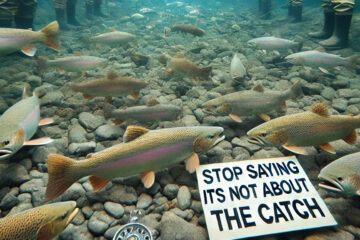
GRAYLING, Mich. (AP) — In the decades since Robert Redford’s film adaptation of Norman Maclean’s A River Runs Through It, fly fishing has grown from a pastime of poets and hippies into a multibillion-dollar industry serving anglers from all walks of life. Now, new rules from the National Association of Trout and Salmonoids (NATS) that end transfer restrictions and provide more generous name, image, and likeness (NIL) opportunities are poised to transform trout fishing in America.
In the past, tackle manufacturers, destination lodges, and travel agencies have been the big winners. But the Supreme Court’s recent judgment in Brown v. Montana has opened avenues for trout and other salmonoids to benefit from this boom.
“After just a few years of NIL and immediate transfers in NCAA sports, it’s easy to forget that student-athletes were once deprived of their earning potential and mobility,” said Art Jengus, the attorney who represented Madison Brown in the Brown v. Montana case. “But while the shackles came off the athletes, we saw a proliferation of trout images and likenesses on Facebook, Instagram, YouTube, catalogs, magazine covers, and film festivals, all without any compensation for the stars. Our fish were being exploited, but no one seemed to care.”
In Brown v. Montana, Mr. Jengus argued that trout such as his client, Madison Brown, were entitled to compensation. The State of Montana countered that, because trout had no use for money, a simple “thank you” should suffice, to which Mr. Jengus responded by dropping a large grasshopper into Madison Brown’s aquarium, resulting in the “rise heard ‘round the world.”
“Having established to the court that trout could be compensated,” Mr. Jengus said, “the case for a transfer portal logically—and legally—followed. If a trout’s earning potential is limited by the size of its market, it would violate every antitrust law in the country to artificially restrict its ability to move to the river with the highest bid.”
The new rules announced by NATS specify that game fish of the family Salmonidae are allowed—and required—to earn compensation (including food, private spawning redds, and soft-plastic toys) from third parties for the use of their name, image, and likeness on clothing, social posts, multi-media appearances, and implied endorsements. They can work as individuals or with agents or marketing representatives to help secure deals.
Regarding transfers, qualifying fish from recognized trout water can transfer and immediately be eligible to compete in their new water, provided they meet size standards, are in good standing with NATS, and satisfy any progress-toward-growth rules. The temporary “year-in-residence” sit-out requirements are now eliminated. In the past, a large trout in a relatively unknown river was destined to live out its life with virtually no chance to appear in social media, short films, or a traditional print magazine. A trout like that can now enter the portal and move immediately to a prominent river like the Madison or the Missouri, no longer restricted to live out its life in obscurity.
In support of the 6-3 court decision motivating the new rules, Justice Harold Wexler wrote, “The fact that compensation may be unconventional does not render it meaningless. When a likeness is monetized, the subject of that likeness cannot be said to be uncompensated. To do so would be to adopt a theory of commerce that turns solely on the preferences of the beneficiary. This court rejects that position.”
In dissent, Justice Johnny Leno was less persuaded. “For God’s sake, people, we’re talking about fish,” he wrote.